AI Pricing Is on the Rise — Yet Still Multiples Below the Value It Delivers
GitHub recently announced that GitHub Copilot (an AI-powered coding assistant) is moving to a usage-based billing model. Starting June 1, 2026, every plan will include a monthly allotment of GitHub AI Credits, with the option to purchase more. Usage is calculated on token consumption — input, output, and cached tokens — at the listed API rates for each model. You can read the full announcement on the GitHub Blog.
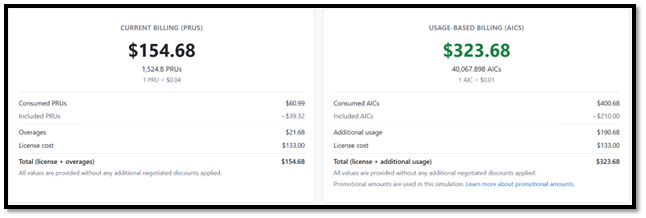
To their credit, GitHub built a preview tool that lets you upload a recent bill and see exactly what it would have costed under the new model. We ran one of our GitHub CoPilot bills so we would have an apples-to-apples cost comparison - The cost under the new cost model more than doubled compared to the existing cost model.Yet we're still pressing our team to use GitHub Copilot more.
Here's why the math works for us to still press our team to use AI such as CoPilot GitHub even though they are doubling their price overnight.
The Real Numbers
Below is the side-by-side of our preview bill. Same usage. Two pricing models.
Current pricing model is on the left using “PRUs” which are Premium Requests as the main metric. The New Usage-Based pricing model is on the right using “AICs” which are AI Credits.
Current billing (PRUs): $154.68
Usage-based billing (AICs) starting June 1, 2026: $323.68
That's a 109% increase. Effectively, AI just doubled in price — overnight.
A few years ago, a line item on a software bill jumping that much would have triggered a procurement review, a vendor renegotiation, and probably a search for alternatives. This time, we didn't flinch.
Why We're Still All In
The honest answer: even at the new price, GitHub Copilot is one of the highest-ROI tools on our stack. When we look at what our engineers ship in a week — and how much of that velocity is attributable to AI-assisted coding, code review, and refactoring — the math isn't close.
A few hours of a Senior Developer's time are worth more than what these tools cost in a month. If GitHub Copilot saves each engineer even an hour or two a week — and in practice, it saves far more — the tool pays for itself many times over by the end of the first week. 
The pricing change didn't change that calculus. It tightened the multiple. The value is still way ahead of the cost.
We're Not Just Paying More — We're Asking for More
Here's the part that might surprise you. We're not absorbing this increase reluctantly. We're actively pushing our team to lean on GitHub CoPilot and other similar AI tools even more.
More prompts. More agent-mode workflows. More AI-assisted code review. More automated test generation. The new pricing model rewards heavier usage with better tooling and richer models, and we want our engineers to be fluent in all of it. The teams that will out-deliver their competitors over the next two years are the teams who treated AI as a power tool, not a novelty.
Said differently: the cost of underusing AI is far higher than the cost of using it more.
What This Means for Mid-Market Leaders
If you're running a technology, operations, or finance organization, the GitHub announcement is a useful canary. AI pricing across the industry is shifting toward usage-based models — OpenAI, Anthropic, Microsoft, Google, and now GitHub. Per-seat pricing was the on-ramp. Usage-based pricing is what mature AI economics look like.
Three implications worth thinking about:
Budget for AI as a variable cost, not a fixed one. The companies treating AI as a flat line item are about to be surprised. Build a usage forecast. Track it monthly. Tie it back to output. Do NOT shut people down or have them stop using AI tools once you burn through your monthly estimate – ensure it is being used efficiently and allocate more to maintain productivity.
Measure value, not just spend. Doubling costs is only painful if you can't measure productivity, accuracy, or time-savings on the other side of the ledger. Most companies still aren't measuring this rigorously. They should be.
The cost-of-inaction is climbing faster than the cost-of-action. Every month a team isn't using AI competently is a month of compounding deficit against competitors who are. The pricing increase doesn't change that — it accelerates it.
The Bigger Picture
We talk to leaders every week who are still trying to decide whether AI is worth the investment. The conversation is usually framed around cost, risk, and uncertainty.
It should be framed around opportunity cost.
A doubled bill for a tool that makes your team materially faster, more accurate, and more capable is not a problem, at least not at these prices; it's a bargain. The window to build a real competitive edge with AI is still open. It will not stay open forever.
That's the lens we use with our clients when we help them evaluate AI investments, build out their Microsoft Fabric and Power BI environments, or integrate Copilot and other AI capabilities into their custom applications. The right question isn't "What does it cost?" It's "What is it worth — and what does it cost not to act?"
Ready to Run the Same Math for Your Business?
If you're trying to figure out where AI delivers measurable value in your operations — and how to budget it intelligently as usage-based pricing becomes the norm — we can help. SDP works with mid-market and enterprise clients to turn AI from a line item into a competitive edge.
Let's talk. Visit sdpstl.com or reach out directly.
ABOUT THE AUTHOR
Mike is the CEO and founder of Software Design Partners (SDP), a software, data, and artificial intelligence consulting firm focused on delivering technology solutions that drive measurable business improvement.



.png)
.png)

